


The New World of Generative Engine Optimization
March 9, 2026 - David Hall
Category: Artificial Intelligence/GEO
Artificial intelligence is changing online search. Besides dedicated AI-powered search engines such as ChatGPT, Perplexity, Microsoft Copilot, and Claude, Google is now regularly answering routine Google searches with an AI overview from its AI assistant, Gemini. Some searchers are going directly to one of the popular AI assistants. But almost everyone is confronted by Google’s AI summaries for some searches.
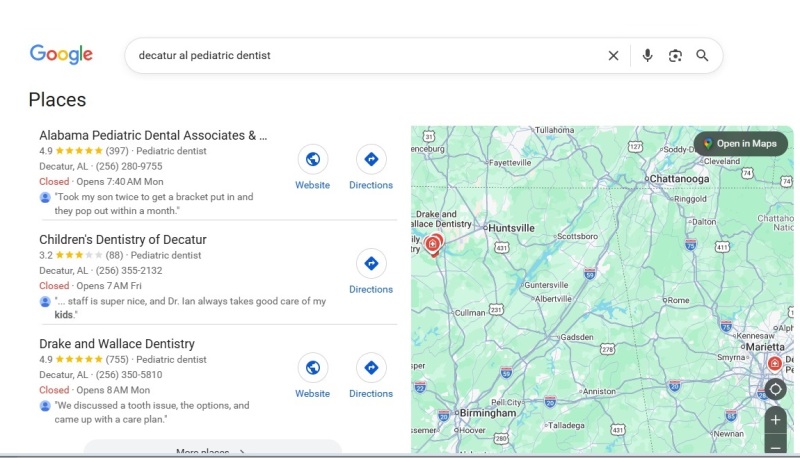
To illustrate, here is a Google search for Decatur, AL pediatric dentist. It returns a conventional list of results:
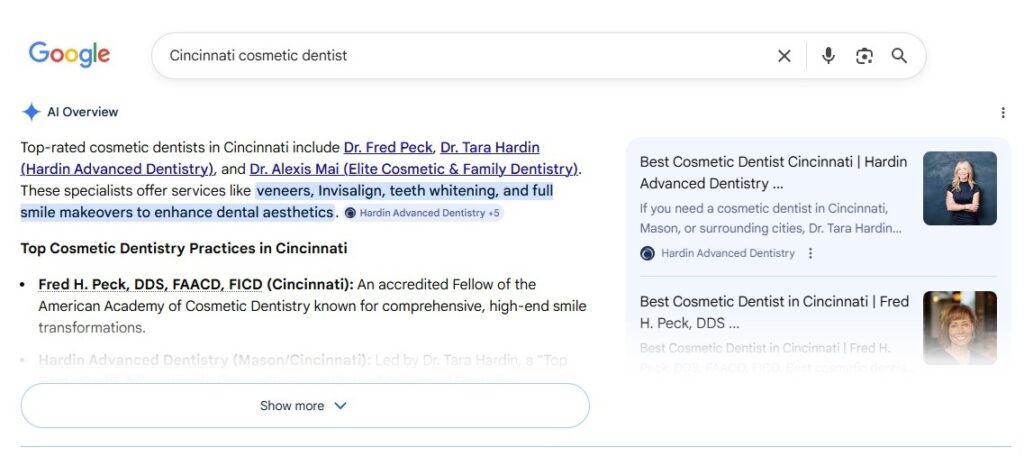
But if I search for Cincinnati cosmetic dentist, for some reason Google returns an AI overview at the top of the page, created by Gemini, that tries to tell me who are the best cosmetic dentists in Cincinnati:
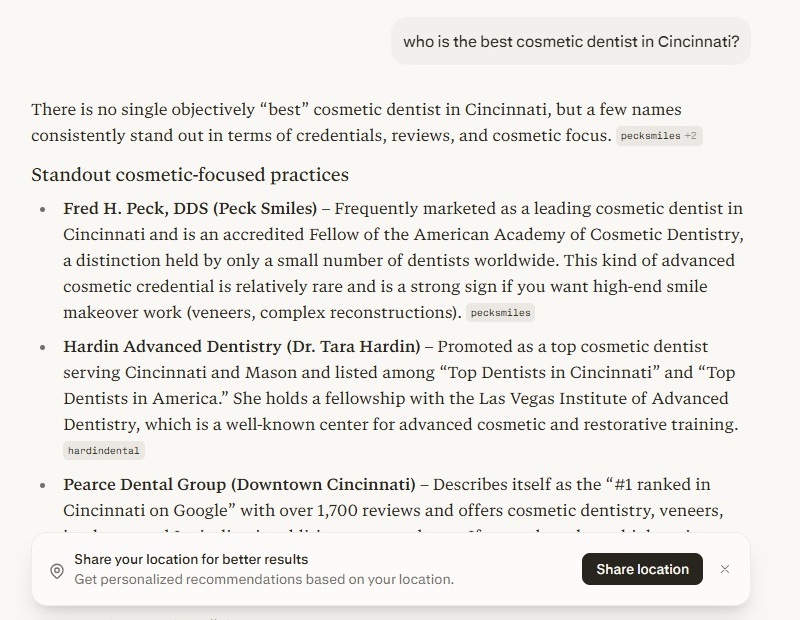
We can also go to perplexity.ai and ask, “Who is the best cosmetic dentist in Cincinnati?” and we will get this result, with our client, Dr. Peck, leading the list and drawing from information we put into his website:
With this growing exposure we are getting to AI-assisted searches, we are responding by adding Generative Engine Optimization to the menu of services we offer clients.
Generative Engine Optimization, or GEO, is defined as the optimization activities that are designed to help a a website show up in artificial intelligence searches. It adds a new twist to the decades-old art of Search Engine Optimization, or SEO. Everything we have been doing for SEO applies to GEO, but there some additional requirements.
Here are the three basic ingredients in effective GEO:
- One is the substance of the content on the website—providing the answers that AI robots are looking for. This is where Generative Engine Optimization can have the strongest impact.
- The second is how the information on the website is structured and coded to facilitate the work of AI robots that are crawling the site.
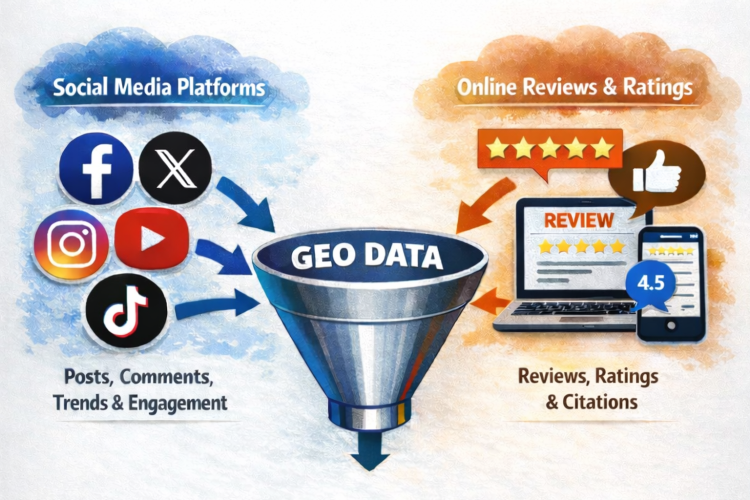
- The third is off-site optimization, including social media platforms, reviews, and online citations that are being used by AI assistants to gather information about a business.
Answering the Questions People Ask
 Answering these questions provides key material for the AI engines. So for clients choosing this service from us, we will create FAQ content providing the answers people ask.
There are some excellent online tools for discovering the questions people are asking. One of the easiest is to just ask the AI assistant. But we want to go beyond that because we have learned through our experience in optimizing many dental websites over the years that the questions asked by patients who are actually making an appointment aren’t the same as generic questions picked up online. So we have developed a system, which we don’t want to discuss publicly, for getting what we call “high-conversion” questions and using them to populate FAQ pages.
Structuring the Website for LLM Robots
A Large Language Model (LLM) is an artificial intelligence model, such as Gemini, ChatGPT, etc., that is trained to understand and generate human-like text by learning patterns from enormous collections of data. Each LLM will have a robot that crawls the internet for data to feed its data repository. Generative Engine Optimization includes structuring information on a website to facilitate the work of these robots in gathering and organizing their data. Here are some aspects of that technical structure:
Adding an llms.txt file.
An llms.txt file is a proposed (but not officially standardized) text file that we can place in your website’s root directory—similar to robots.txt—to give guidance to LLMs about how their content should be used. It tells AI systems whether they are allowed to use your content for training. It defines usage limits. And it offers a canonical source for citation.
Adding an html table on core pages
An html table is a structured way to display data in rows and columns on a webpage. It gives a clear structure to LLM robots to reduce ambiguity and make comparisons explicit, improving the reliability of their data. Thus it improves your chances of being quoted in AI answers.
Using bulleted lists
Bulleted lists similarly improve the clarity of information.
FAQ schema markup
Content that is created to answer the questions people are asking are coded with a special structured data markup that lets the LLM robot understand the content better.
Giving instructions to LLM robots in the robots.txt file
The robots.txt file should include instructions on how we want AI robots to crawl the site and which directories we want to include or block. For example, some directories just contain style information or technical specifications for which there is no need for a robot to visit.
Off-Site Optimization
LLM robots will pull information about your practice anywhere they can find it. Your website is their primary source, but they will also look at social media sites, online reviews, and any place that mentions you. Practices that expertly manage all of this off-site information will generate the most respect in this new AI world.
Online reviews, of course, can’t be controlled by you. But you will be ahead here if you have a way to encourage all your patients to leave reviews. Otherwise you will find that complainers will be more likely to leave reviews and depress your rating. Plus, LLMs seem to be impressed by large quantities of reviews.
A note about citations: There are thirty or more online directories that list dental practices. Here are some of the more prominent ones:
- Healthgrades
- Zocdoc
- Yelp
- topDentists
- etc.
For clients who want GEO services, we strongly encourage also using our Local Search services, to manage the information being provided by these directories. It is also helpful to have us manage your social media accounts.
Interested? Click Here
A Final Word
This is a new world—AI-assisted search. Things are still developing. It is causing consumer search behavior to change. Understanding that changing consumer behavior is key to making our GEO successful for our clients. we love the challenge of keeping our fingers on the pulse of what is going on and devising strategies to deal with that. At Infinity Dental Web, this is one of the things that makes online marketing so exciting to us— You can rely on us to be at the leading edge of developments.
If you are interested in our GEO services, let us know. There will be a setup fee of $595 and then a monthly fee of $595/month for the first year, with a minimum commitment of one year. After that, the fee will drop to $450/month. For clients who sign up in our introductory period, we will waive the setup fee.
I find it crazy how much my own searching habits have changed in the last year or so. I am a fan of Perplexity.